 By Admin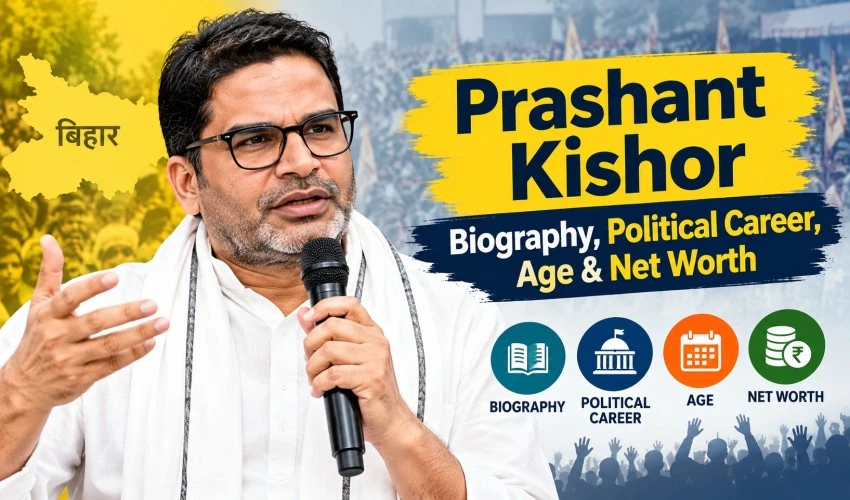
Few people in Indian politics have moved from backroom strategist to elected legislator the way Prashant Kishor has. He spent years designing winning campaigns for other leaders, then built his own party and, in 2026, won his first election. This guide covers his early life, career, age, controversies and declared wealth.
Quick Facts
- Full name: Prashant Kishor (often called “PK”)
- Date of birth: 20 March 1977
- Age: 49 years (as of October 2026)
- Birthplace: Konar village, Rohtas district, Bihar
- Profession: Political strategist turned politician
- Party: Jan Suraaj Party (founder)
- Current role: MLA, Bankipur constituency, Bihar
- Spouse: Dr Jahnavi Das, a physician
Early Life and Education
Kishor was born on 20 March 1977 in Konar village, and he worked in public health before turning to politics. He grew up in Bihar and finished school in Buxar. His affidavit says he passed Class 10 at a high school in Buxar in 1991 and Class 12 at Patna Science College in 1993. He later worked with the United Nations on public health projects, including a posting in Africa, which gave him experience in large-scale data and organisation that he later applied to campaigns.
The Strategist Years
Kishor first came to national attention during the 2014 Lok Sabha election, when he helped run the high-profile campaign for Narendra Modi. He then founded the Indian Political Action Committee (I-PAC), which turned election strategy into a professional service built on data, ground surveys and branding.
His clients and campaigns included:
- 2015 Bihar: The Nitish Kumar–Lalu Prasad alliance
- 2017 Punjab: The Congress under Captain Amarinder Singh
- 2019 Andhra Pradesh: YSR Congress and Jagan Mohan Reddy
- 2021 West Bengal and Tamil Nadu: Trinamool Congress and the DMK
Not every campaign succeeded. The 2017 Uttar Pradesh election, where he worked with the Congress, is described as the one time he failed to help a party win. Still, his overall record gave him a reputation as an election wizard, and it is the reason his later political moves drew so much attention.
Joining and Leaving the JD(U)
Kishor joined the Janata Dal (United) on 16 September 2018 as its vice-president. The relationship with Nitish Kumar did not last. Disagreements over issues such as the Citizenship Amendment Act led to his exit in early 2020. He later stepped away from running electoral consultancy and shifted towards building a political movement of his own.
Jan Suraaj: From Movement to Party
Kishor began preparing for a Bihar-focused effort around 2022. The party grew out of the Jan Suraaj Abhiyan, a grassroots movement that he started in 2022. He walked thousands of kilometres across the state on a padyatra, holding meetings on education, jobs, migration and governance.
On 2 October 2024, Kishor officially announced the formation of the Jan Suraaj Party. He promised a politics built around development rather than caste arithmetic, and he also pledged to scrap Bihar’s liquor ban if his party came to power. He later handed organisational roles to others, naming former BJP MP Uday Singh as the party’s first national president so he could focus on public outreach.
The 2025 Assembly Election: A Tough Debut
The party’s first major test came in the 2025 Bihar Assembly election. Jan Suraaj contested 238 seats without an alliance, and Kishor himself did not stand. The result was a setback. The party failed to win any seat in 2025. Critics called the experiment a failure, but supporters pointed to the party’s quick organisational spread and its ability to put new issues on the agenda.
The Bankipur Victory
The turning point came in 2026. A vacancy opened in Patna’s Bankipur seat, long considered a BJP stronghold, and Kishor chose to contest it personally. He polled 64,151 votes against 44,827 for the BJP’s Neeraj Kumar Sinha, winning by 19,324. The win made him the first legislator elected on a Jan Suraaj ticket. He took the oath as an MLA on 17 August.
Since then he has kept campaigning across Bihar, including backing candidates in teacher and graduate constituency elections for the Legislative Council. He also remains openly critical of the NDA and the RJD, arguing that both rely on caste and fear. Recent reports show him welcoming political figures such as Mokama MLA Anant Singh, who has supported a Jan Suraaj candidate, although no move by Singh to leave the JD(U) or formally join Jan Suraaj has been announced.
Net Worth: What the Affidavit Says
Net worth figures for public figures online are often guesses, so the most reliable source is the sworn affidavit he filed for the Bankipur bypoll. He declared total assets of more than ₹96 crore, made up of ₹22.19 crore in movable assets and ₹73.87 crore in immovable assets. His declared liabilities are about ₹5.78 crore. That puts his declared net worth at roughly ₹90 crore on paper.
Some other details from the filings:
- His wife, Jahnavi Das, declared assets of ₹101.93 crore, more than his own.
- Kishor owns Vedha Venture Private Limited, which donated ₹85 crore to the Jan Suraaj Party in 2024–25.
- His immovable holdings include residential properties and a dismantled rice mill in Bihar.
These numbers reflect declared values at the time of filing and may differ from current market value. His wealth is widely linked to his earlier consulting career, though the affidavit itself does not itemise income sources in the summaries available.
Controversies and Legal Cases
His affidavit lists eight pending criminal cases against him, and no charges had been framed. The allegations mentioned in coverage include defamation, obstructing public servants and fraud. Pending cases are not convictions, and politicians in India frequently carry such cases tied to protests and campaigns, but readers should follow court developments for the latest status. He has also faced scrutiny over party funding, since a company he owns has been a major donor.
Strengths and Challenges Ahead
Kishor’s strengths are clear: strong communication skills, deep knowledge of campaigns and an issue-based pitch that resonates with young and migrant voters. His challenges are equally real. Jan Suraaj has one seat in the Assembly, and building a durable organisation across 243 constituencies takes years. Bihar’s politics is still shaped by caste coalitions, and the next major test will be the Lok Sabha election.
Final Thoughts
Prashant Kishor’s story is one of reinvention: from public health worker to the country’s best-known election strategist, then to a party founder who survived a failed debut and won on his second attempt. At 49, with a seat in the Bihar Assembly and a growing platform, he remains one of the state’s most closely watched figures. Whether Jan Suraaj becomes a lasting force or stays a niche movement will depend on what he does with this moment.